Our Team
Dr. Samuel Woolley
Director
Dr. Samuel Woolley is the Director and Principal Investigator of the Communication Technology Research Lab (CTRL) at the University of Pittsburgh. He holds the William S. Dietrich II Endowed Chair of Disinformation Studies and is an associate professor in the Department of Communication at Pitt. Before this, Dr. Woolley was an associate professor and the fellow of the R.P. Doherty Sr. Centennial Professorship in Communication in the School of Journalism and Media at the University of Texas at Austin, where he also directed the Propaganda Research Lab at the Center for Media Engagement. He has past academic affiliations at the University of California at Berkeley, the University of Oxford, Stanford University, the University of Washington, and others.
Over the course of his career, Dr. Woolley has focused his attention on how various groups around the world use emerging media technologies in bids to control information flows and manipulate public opinion. He has also studied how activists, journalists, and other organizations use these same technologies for the purposes of democracy and human rights. His research has examined: 1) how governments, political campaigns, and other political groups use fake and coordinated online profiles to amplify favorable content, 2) how companies, pyramid schemes, and spammers leverage social media, automation, artificial intelligence, and groups of influencers to suppress and attack opposition, 3) how hackers, hate groups, organized crime entities, and scammers manipulate trending and recommendation algorithms in attempts to make certain types of information ‘go viral’, and 4) how community groups, journalists, and grassroots organizations work to build ground-up responses to challenges posed by the digital information environment.
Prior to joining UT Austin, Dr. Woolley was co-founder and research director of the Computational Propaganda Research Team (now Programme on Democracy and Technology) at the University of Oxford. He is also the founding director of the Digital Intelligence Lab at the Institute for the Future, a think-tank based in Palo Alto, California. He has held fellowships across civil society, tech, and the academic sector, including as a resident fellow at the German Marshall Fund of the United States, a Belfer Fellow at Center for Technology and Society at the Anti-Defamation League, a research fellow at Google Jigsaw, an associate fellow at GLOBSEC, and a research fellow at the Tech Policy Lab at the University of Washington. He has led scholarly work supported by large grants from the U.S. National Science Foundation, the European Research Council, Omidyar Network, the Knight Foundation, the Miami Foundation, the Hewlett Foundation, the Ford Foundation, the New Venture Fund, and others.
Dr. Woolley is the author or editor of four books on social media, technology, and informational manipulation. Manufacturing Consensus: Propaganda in the Era of Automation and Anonymity (Yale University Press, 2023) explores the ways that bots, influencers, and other tools and tactics have become global mechanisms for creating illusions of political support or popularity. This book won the Association of Internet Researcher’s (AoIR) Nancy Baym Annual Book Award, which “seeks to recognize the best work in the field of Internet Studies. Bots (Polity, 2022), co-authored with Nicholas Monaco, is a primer on how automated and AI tools are integral to the flow of information online. The Reality Game: How the Next Wave of Technology Will Break the Truth (PublicAffairs, 2020) examines the ways in which emergent technologies–from AI to virtual reality–are already being leveraged to manipulate public opinion, and how they are likely to be used in the future. Computational Propaganda: Political Parties, Politicians, and Political Manipulation on Social Media (Oxford University Press, 2018) is a volume of country specific case studies looking at the rise of social media–and tools like algorithms and automation–as mechanisms for manipulation around the world. His fifth book, forthcoming via the University of Chicago Press, is co-authored with Dr. Inga Trauthig. It is tentatively titled Encrypted Propaganda: The Democratic Promise and Despotic Peril of Messaging Apps and examines how both top-down and bottom-up groups use encrypted and private messaging spaces to communicate, inform, and manipulate. His research has been translated into several languages, including Chinese, German, French, Japanese, Korean, Persian, Portuguese, Spanish, Russian, and Ukrainian.
He has published numerous peer-reviewed articles, book chapters, and white papers on emergent technology, the internet and public life in publications such as New Media & Society, PLOS ONE, Social Media+Society, Journalism Studies, the Journal of Information Technology and Politics, Journal of Experimental Psychology: General, Journal of Democracy, Political Communication, Big Data & Society and others. He regularly writes about technology and information for popular venues including The Guardian, The New York Times, MIT Technology Review, Slate, Wired, Foreign Affairs, and The Atlantic. He has created interactive work based on his research that has been shown in the Victoria and Albert Museum and the Swedish Centre for Architecture and Design (ArkDes). He has testified on his research related to informational manipulation, voting, and US communities of color before the U.S. Congress and presented work to members of the UK Parliament, NATO, and the United Nations.
His PhD is from the University of Washington in Seattle.

Recent Posts
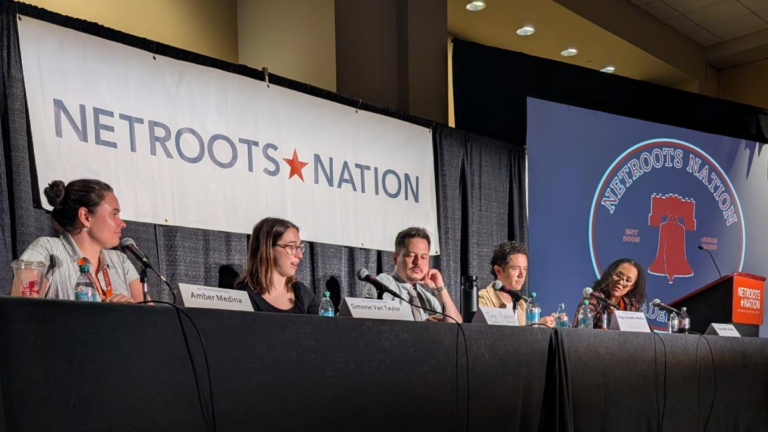
At Netroots Nation, Progressives Divided on AI

BlackRock Takes On Conspiracy Bots as Misinformation Risk Grows

How personal finance advice is getting political, thanks to ‘finfluencers’

Generative AI, Emerging Technology, and Political Communication